







ADA Compliance Checklist for California Commercial Properties
ADA compliance is not only about fixing visible barriers after a complaint. For commercial properties, the strongest approach is to evaluate the site, document the conditions, prioritize corrections, and coordinate construction around measurable accessibility requirements.

Quick Takeaways
- ADA compliance starts with accurate site conditions. Measurements, slopes, routes, signage, and transitions need to be reviewed before construction scope is finalized.
- Parking lots are one of the most common problem areas. Accessible stalls, access aisles, curb ramps, detectable warnings, and path-of-travel conditions should be evaluated together.
- CASp coordination can support better documentation. When appropriate, a Certified Access Specialist can help identify barriers and clarify corrective priorities.
- Construction planning matters. Corrective work should be scoped around code, site constraints, permits, phasing, and long-term durability.
ADA compliance for commercial properties is easiest to manage when it is treated as a site-wide process. A single noncompliant element may seem minor on its own, but accessibility failures often happen when parking, curb ramps, sidewalks, slopes, entrances, and signage are reviewed separately instead of as one connected path of travel.
This checklist is designed to help property owners and managers understand the main areas that should be reviewed before planning ADA corrections, CASp coordination, or accessibility construction. It is not a substitute for a formal inspection, but it can help you prepare for a more organized evaluation.
1. Start With the Accessible Parking Area
Accessible parking is often the first area visitors experience and one of the most visible parts of an ADA compliance review. A property may have blue paint and signage but still have issues with stall dimensions, access aisle layout, slope, surface condition, or connection to the accessible route.
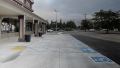
Parking items to review
- Accessible stall count and location
- Van-accessible stall requirements where applicable
- Access aisle placement and striping condition
- Surface slope and cross-slope conditions
- Sign placement, visibility, height, and orientation
- Connection from parking to the accessible route
Paint alone does not make a parking stall compliant. The constructed surface, slope, curb ramp transition, and route connection all matter. This is why ADA parking corrections often involve both striping and construction work.
2. Review the Accessible Route From Parking to Entrance
The accessible route connects arrival points to the building entrance and public-use areas. On many commercial properties, the route may cross parking lots, drive aisles, curb ramps, sidewalks, landings, and entrance approaches. Each transition should be reviewed for usability and compliance.
ADA corrections are most effective when the property is evaluated as a continuous route, not as a list of disconnected repairs.
Common route issues include excessive slopes, uneven transitions, broken concrete, missing curb ramps, narrow sidewalk areas, obstructions, and routes that force users into vehicle traffic. Even if a building entrance is accessible, the property can still create compliance concerns if the path to reach that entrance is not accessible.
3. Check Curb Ramps, Landings, and Detectable Warnings
Curb ramps and transitions are key points in accessibility construction. They often require precise grading, clean tie-ins, and durable materials. A curb ramp that looks visually acceptable may still fail because of slope, cross-slope, landing, flare, or transition conditions.
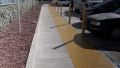
Construction note
When curb ramps are corrected, the surrounding concrete and asphalt may also need to be adjusted. The goal is not only to install one compliant feature, but to create a usable transition that works with the full route.
4. Inspect Entrances, Doors, and Thresholds
Entrances should be reviewed for clear approach, landing conditions, door maneuvering space, threshold height, hardware usability, and the transition from exterior walkway to interior floor surface. Entrance issues are especially important for retail centers, restaurants, medical offices, hotels, office buildings, and public-facing commercial properties.
Small transition problems can create major usability issues. Raised thresholds, tight approaches, missing landings, or door hardware that is difficult to operate may affect how accessible the entrance is for customers, tenants, visitors, and employees.
5. Evaluate Signage and Wayfinding
Signage helps users identify accessible parking, entrances, routes, restrooms, and other key features. Signs should be reviewed for location, visibility, mounting, content, and relationship to the access element they identify.
- Accessible parking signs should be visible and properly associated with the designated stall.
- Directional signage may be needed when the accessible entrance is not obvious.
- Interior signage may be relevant for restrooms, public areas, and accessible features.
- Old, damaged, missing, or poorly placed signs can create confusion and increase compliance risk.
6. Consider CASp Coordination When Risk or Scope Requires It
A Certified Access Specialist can provide formal review and documentation of accessibility barriers. For properties with prior complaints, repeated issues, major renovations, public accommodation concerns, or unclear conditions, CASp coordination may help clarify the scope and support a more structured correction plan.
This does not replace construction planning. Instead, it helps inform which barriers need correction, how those barriers should be prioritized, and how the work should be documented.
7. Build a Prioritized Remediation Plan
After the evaluation, the next step is deciding how to correct the issues. A strong remediation plan should identify what needs to be corrected, what trade work is involved, whether permits are required, how the work affects operations, and which items should be completed first.
| Area | Common Review Item | Planning Consideration |
|---|---|---|
| Parking | Stall layout, striping, signs, slope | May require asphalt, concrete, striping, and signage coordination |
| Route | Walkways, transitions, width, surface condition | Should connect arrival points to accessible entrances |
| Curb Ramps | Landings, flares, warning domes, tie-ins | Often requires precise grading and surrounding surface work |
| Entrance | Thresholds, door clearance, approach space | May involve hardware, concrete, landing, or doorway corrections |
8. Document the Work Before, During, and After Construction
Documentation helps property owners understand what was evaluated, what was corrected, and how the final construction aligns with the planned scope. Photos, measurements, reports, permits, and final verification records can all support a more organized compliance file.
For larger properties or multi-site portfolios, documentation also helps future maintenance teams avoid undoing accessibility work through resurfacing, restriping, landscaping changes, or tenant improvements.
Final Thoughts
ADA compliance is best approached as a measured construction and planning process. The goal is not simply to check boxes, but to create a property that is easier to access, easier to maintain, and better prepared for future inspections, tenant changes, or improvement projects.
For commercial properties in California, working with a construction team that understands accessibility evaluation, CASp coordination, concrete, asphalt, grading, striping, signage, and permit pathways can make the process more efficient and more reliable.